Filming Your Own Lessons to Become a Better Teacher
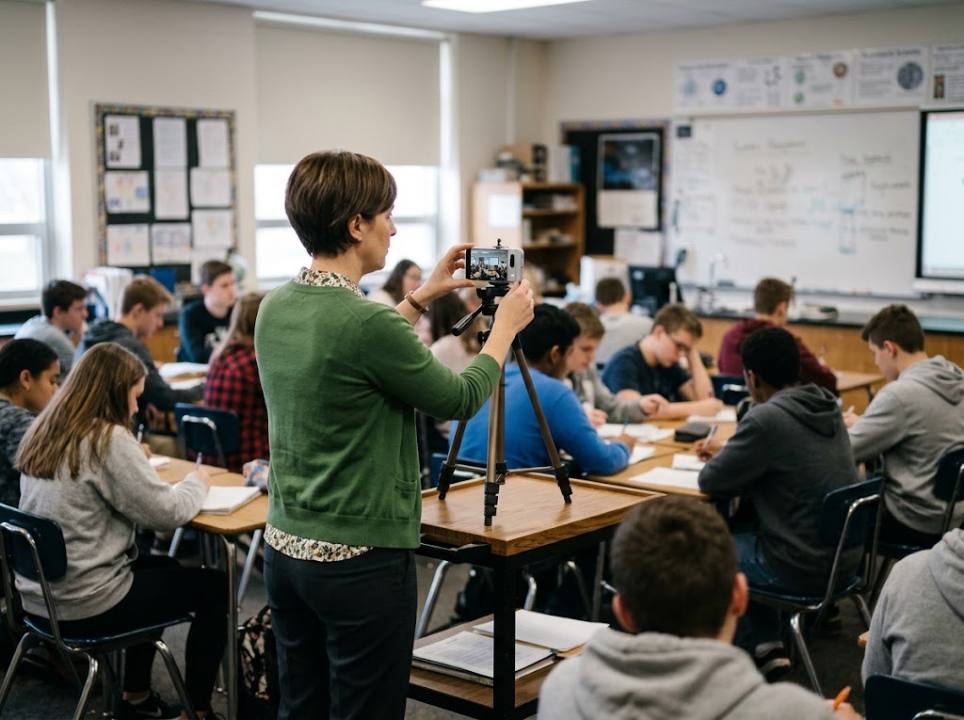
Most teachers have never watched themselves teach. They plan lessons, deliver them and reflect afterwards, but that reflection relies on memory, and memory is generous. Recording a lesson changes everything. The first viewing is usually uncomfortable. The second is fascinating. By the third, most teachers have spotted habits they never knew they had.
Teaching videos have become a normal part of professional development, coaching and even teacher certification in many countries. Here is how to make them genuinely useful.
Why video beats memory
During a lesson, a teacher is juggling timing, behaviour, questions and a dozen small decisions every minute. There is simply no space to notice everything. A camera at the back of the room does not get tired or distracted. It shows who answered questions, how long you waited after asking one and which corner of the room received almost no attention.
The most common discovery is wait time. Teachers often believe they pause for several seconds after a question. Video usually shows they wait less than two before answering it themselves or calling on the same confident pupil.
Setting up without fuss
You do not need professional equipment. A smartphone on a small tripod, placed at the back or side of the room, captures enough. A clip-on microphone improves sound a lot if you want to analyse your questioning or explanations.
- Check your school policy on recording and pupil consent first.
- Point the camera at yourself and part of the class, not individual faces.
- Record a full lesson rather than a highlight. Ordinary moments teach the most.
- Store files securely and delete them once you have finished reviewing.
What to look for
Watching a whole lesson without a focus can be overwhelming. Choose one lens at a time.
- Questioning: What kind of questions do you ask, and who answers them?
- Explanations: Are instructions clear the first time, or do pupils ask again?
- Movement: Where do you stand, and which pupils never see you close up?
- Transitions: How much time is lost between activities?
- Talk ratio: How much of the lesson is teacher talk compared with pupil talk?
Coaching and peer review
Videos become even more powerful when shared with a trusted colleague or instructional coach. Instead of a one-off observation with a clipboard, the teacher and coach can pause, rewind and discuss specific moments. The conversation moves from judgment to curiosity. "What were you thinking here?" is a very different question from "Why did you do that?"
Some schools build small libraries of short clips showing strong practice, such as a well-run group task or a clever way of checking understanding. New teachers find these far more useful than written guidance.
Teaching videos across borders
Teacher networks increasingly share classroom videos internationally. A school in Norfolk may exchange clips with a partner school in Lyon or Munich. Transcripts and subtitles make these videos accessible, and teams that translate them regularly often use a cat tool to keep subject terminology consistent, so that "formative assessment" or "scaffolding" is rendered the same way in every clip.
For shorter projects, schools and teacher trainers sometimes commission french to english translation services for commentary and reflection notes written by partner teachers in France.
Video and teaching certification
In several countries, recorded lessons form part of formal assessment. Trainee teachers may submit clips as evidence of competence, and experienced teachers moving abroad sometimes need to prove their classroom practice alongside their qualifications.
Teachers who trained in Germany and want to work in the UK, for example, must present degree certificates and teaching qualifications to the relevant authority. The UK government explains the route on its page about qualified teacher status. Official documents usually need certified german translation services so that the English version is accepted without delay.
Turning observations into action
Noticing a habit is only half the job. The value of a teaching video comes from what you change afterwards. A simple cycle works well: watch, choose one small adjustment, try it for two weeks and record again. If the clip showed short wait time, the next goal might be counting silently to five after every question. If transitions were slow, the target might be a clear signal and a visible countdown.
Keeping a short log of each recording, the focus and the change you tried, turns a series of clips into a record of real professional growth. That log is also useful evidence during appraisals, job interviews and applications for leadership roles, where schools want to see how a teacher reflects and improves rather than only what qualifications they hold.
Getting past the discomfort
Almost every teacher dislikes the first recording. The voice sounds strange, the gestures look exaggerated and small mistakes feel enormous. That feeling passes quickly. After a few recordings, most teachers stop watching themselves and start watching their pupils. That shift is where real professional growth begins.
A simple habit with lasting benefits
Recording one lesson each half term, choosing one focus and discussing it with a colleague is enough to make steady progress. It costs nothing, takes little time and gives more honest feedback than any formal observation. For teachers who want to keep improving throughout their careers, a camera may be the most valuable tool in the room.