Teaching Strategies for Multilingual Classrooms That Work
Walk into almost any school today and you will hear more than one language in the corridor. A Year 4 class might include children who speak Polish, Arabic, Tagalog and Ukrainian at home, alongside pupils who have only ever spoken English. For teachers, this is both a gift and a daily puzzle. How do you plan one lesson that works for thirty children who understand instructions in very different ways?
The good news is that multilingual classrooms do not require a completely new teaching method. They reward the same habits that make any lesson clearer, applied with a little more intention.
Start with routines, not vocabulary lists
Newly arrived pupils often feel lost because they cannot predict what will happen next. Consistent routines solve a large part of that problem before a single word is learned. When the day always begins with the same greeting, the same visual timetable and the same place to hang coats, children relax and start paying attention to language instead of worrying about what is coming.
Predictability is the first scaffold. A visual timetable with pictures, a signal for tidy-up time and a fixed spot for homework trays give every child the same anchor, whatever language they speak.
Make meaning visible
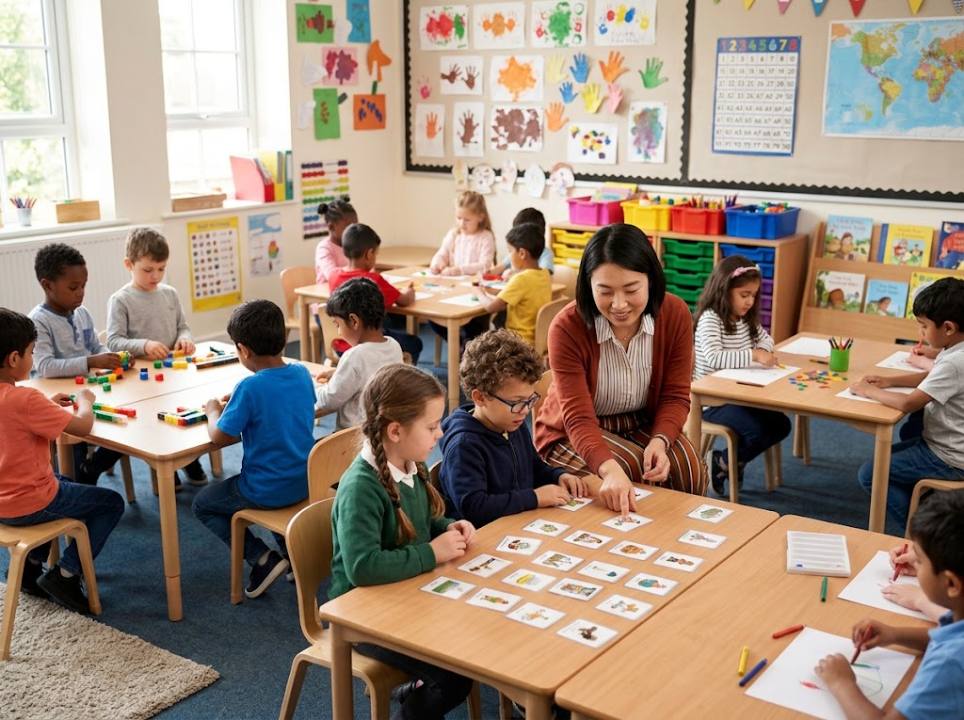
Teachers who work well with language learners tend to show more and say less. They model tasks, use real objects, draw quick diagrams and point to key words on the board. Sentence starters such as "I think that..." or "First, second, finally" help pupils take part in discussions long before they can build sentences on their own.
- Pair every key instruction with a gesture or picture.
- Pre-teach three or four essential words before a new topic.
- Use word walls with images and simple definitions.
- Check understanding with thumbs up, mini whiteboards or quick sorting tasks rather than "Does everyone understand?"
Let home languages work for you
For a long time, schools discouraged children from using their first language in class. Research now points the other way. Pupils who can talk through a maths problem with a classmate in Ukrainian or Russian often understand the concept faster and then explain it in English. The home language becomes a bridge rather than a barrier.
Useful approaches include pairing new arrivals with a buddy who shares their language, allowing bilingual glossaries and inviting children to label classroom objects in several languages. Organisations such as Edutopia share many practical examples from teachers who have made this work in real schools.
Communicating with families
Parents are a school's strongest allies, but only if they understand what is happening. Newsletters, permission slips, reports and safeguarding information often reach families in a language they cannot read well. The result is missed trips, unsigned forms and parents who feel shut out.
Many schools that welcomed children from Ukraine in recent years learned this quickly. A single letter in the right language can do more for trust than a dozen well-meaning phone calls. For important documents such as admission forms, special educational needs plans or medical information, schools increasingly rely on professional ukrainian translation rather than asking an older sibling to interpret. The same applies to families from other Eastern European backgrounds, where accurate english to russian translation of school policies helps parents feel informed and respected.
Build a library of reusable materials
Teachers who translate worksheets, welcome packs and letters one by one soon realise they are repeating the same sentences every term. Local authorities and multi-academy trusts that handle this well keep approved wording in translation memory software, so a phrase like "Please return this form by Friday" is translated once and reused consistently across every school.
Even without special tools, a shared folder of bilingual templates saves hours. Welcome booklets, uniform guides and term dates are good places to start.
Assessment that shows what children really know
A child who cannot yet write a paragraph in English may still understand fractions perfectly. Assessment in a multilingual classroom needs to separate subject knowledge from language ability wherever possible. Practical tasks, diagrams, oral explanations and matching activities give a fairer picture than long written answers.
Keeping short notes on each new arrival, including what they could do in their previous school, also helps. Many pupils arrive with strong maths or science backgrounds that simply need a new vocabulary.
Look after the whole child
Some children arrive after difficult journeys. They may be tired, anxious or grieving for friends and family left behind. Calm spaces, predictable adults and patience with silence matter as much as any language strategy. A quiet corner with books in several languages can become a safe place during overwhelming days.
A classroom that speaks many languages
Multilingual classrooms are now normal rather than exceptional. Teachers who build clear routines, show meaning visually, welcome home languages and communicate carefully with families see pupils progress faster than expected. Language diversity, handled well, makes every child in the room a better learner.